
Why This Works
Fearful and aggressive cats have long been dismissed as unmanageable or beyond help, due to misconceptions about socialization and behavior. These cats aren’t mean, they’re just scared. With safe, evidence‑based handling and a solid understanding of feline behavior, we can finally give them the support they’ve been denied.
Giving Fearful Cats the Chance They’ve Always Needed
My handling and socialization methods were developed through extensive work with fearful shelter cats, ones who often arrive overwhelmed, shut down, or defensive and labeled as behaviorally challenging. But the principles behind these techniques are universal. Whether a cat is in a shelter, a veterinary clinic, or a brand‑new adoptive home, the same truth applies: cats need reassurance. Their instincts tell them to be cautious, to hide, and to protect themselves. Intentional, guided interaction, especially outside of confined spaces is what helps them recognize safety, reduce fear, and begin to trust.
Shelters have long understood this with dogs. Fearful, aggressive, or barrier‑reactive dogs are routinely leashed and guided out of their kennels, even when they resist at first. While the initial moment can be stressful, that brief, controlled guidance allows handlers to make a positive connection and move the dog into a calmer environment where fear decreases rapidly. Because kennels are a major source of stress, removing dogs from that space is the foundation of effective behavior support. Decades of shelter experience show that once a dog is out of confinement and working one‑on‑one with a calm handler, their behavior often improves within minutes.
Cats, however, were historically treated differently. They use litter boxes and don’t require daily walks, so shelters never had a built‑in reason to remove fearful cats from their kennels. Most people are uncomfortable handling a cat who is hissing, swatting, or frozen in fear, so the default became the “leave them alone” approach. Without consistent, positive interaction, fear worsens, defensive behavior escalates, and cats remain isolated. Because we lack a “leash equivalent” for cats, they stayed in their kennels, stressed, deteriorating, and misunderstood.
This is reinforced by long‑standing cultural bias. Cats in general have often been viewed more negatively than dogs and fearful ones were immediately labeled as unpredictable, untouchable, or “not worth the risk.” Their defensive behavior is frequently misinterpreted as aggression rather than what it truly is: a heightened response to fear. As a result, cats have historically received far less behavior support than dogs across shelters, veterinary medicine, and general animal care.
Video courtesy of Dogs Playing for Life, an organization dedicated to "improving shelter dogs' experience through playgroups and individualized training.
Many programs rely on medication or in‑kennel socialization to reduce stress. These approaches can help mildly fearful cats, but for cats showing severe fear or aggression, they are often ineffective, unsafe, or too slow. Waiting for a cat to “come around” prolongs isolation and delays the positive interaction they urgently need. We cannot control every aspect of a cat’s life such as their housing, food, and medical care, then claim that socialization is the one area where they should “have a say.” Given the choice, a fearful cat will always choose to hide rather than approach an unfamiliar person.
Withholding support under the banner of “consent” is not compassion, it’s avoidance. These cats did not choose to be in a shelter, clinic, or new home, and many will not improve without guided help. The moment they enter our care, it becomes our responsibility to support them through this transition, even if it means gently nudging them beyond their comfort zone. Attempting socialization inside a kennel can corner them and intensify fear, especially for cats who are defensive in tight spaces or minimally responsive to in‑kennel efforts. For these individuals, out‑of‑kennel socialization is essential.
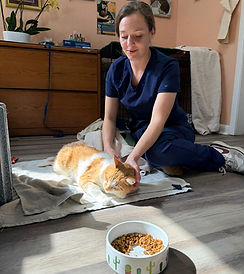
Carefully transferring a fearful cat into a calm, quiet, neutral room changes everything. It gives them space to move, decompress, and feel safe enough to be curious. In this environment, stress decreases far more quickly, and meaningful interaction becomes possible. My intentional handling and socialization techniques were designed specifically for these high‑fear cats. They provide a safe, predictable way to work with even the most aggressive cats, acting as a functional “leash equivalent” that prevents panic and allows trust to form.
Once a cat is out of the kennel and receiving calm, positive interaction, the same pattern seen in dogs appears in cats: fear drops, defensive behavior fades, and confidence builds. In most cases, this shift happens within minutes. Some cats remain wary at first, and because cats are quick, flighty, and prone to panic, allowing them to roam loose in an unfamiliar room can be unsafe. That’s where structured techniques like Bundle & Bond become invaluable. Just as a leash keeps a fearful dog from fleeing before reassurance is possible, these methods safely contain a cat long enough for their nervous system to settle. Once their fight‑or‑flight response downshifts, gentle contact and trust‑building can begin.
These techniques work because fearful cats never needed “behavior modification” to begin with, they just needed reassurance. They are not inherently mean or aggressive; they are scared. Confinement is stressful. New places and people are stressful. Being handled and restrained is stressful. Feeling scared and isolated is stressful. There is no version of working with fearful cats that is truly “fear‑free,” because new environments themselves; shelters, clinics, new homes; are inherently overwhelming to them.
What we can do is choose the approach that minimizes the intensity and duration of that stress. By safely removing cats from confinement and providing immediate, structured, positive interaction, these techniques replace prolonged, isolating distress with brief, manageable stress that leads directly to relief, confidence, and connection. This shift is not only humane, it's essential for their welfare in any environment where cats experience fear.